


GENE SYNTHESIS
JULY 17, 2026 | Read Time: 10 minutes
Building the Blueprint: How DNA Manufacturing Is Scaling to Meet the Next Wave of Therapeutics
Building the Blueprint: How DNA Manufacturing Is Scaling to Meet the Next Wave of Therapeutics
Marc Montserrat, CEO
The future of synthetic biology hinges not just on our ability to design biological systems, but on our capacity to manufacture the DNA behind them reliably, at scale, and inside regulated frameworks.
DNA Synthesis Moves From Lab Bench to Industrial Floor
Over roughly the last twenty years, DNA synthesis has grown into a cornerstone capability across the life sciences, underpinning everything from basic research to drug discovery.[1] Despite that growing importance, it has traditionally been treated as a supporting tool rather than a core pillar of industrial biopharmaceutical production. What unites today’s advanced therapies is a shift toward engineered biological systems that sense and respond with a precision conventional drugs can’t match, the long-promised arrival of “programmable biology.” That shift means DNA can no longer sit at the periphery of discovery and development; it has to be built into manufacturing processes from the outset.[2] It’s not enough to simply synthesize DNA, it must be produced reproducibly, at scale, and to regulatory standard. This reframes DNA synthesis as an industrial discipline, subject to the same rigor that has long governed other corners of biopharmaceutical manufacturing. This trajectory has a precedent. Monoclonal antibody commercialization only became possible once scalable, reproducible manufacturing systems were developed, after which antibody production was gradually standardized into regulated workflows.[3] DNA synthesis appears to be following a similar arc. While innovations like enzymatic synthesis and new assembly methods keep pushing the field forward (Figure 1), the central challenge now is manufacturing performance: DNA destined for therapeutic use must hit strict marks for sequence fidelity, purity, and traceability.[4] Variability that’s tolerable in a research setting simply isn’t acceptable once a product reaches the clinic, where inconsistency can compromise safety and efficacy. DNA synthesis is therefore increasingly judged on industrial robustness, not just technical capability.
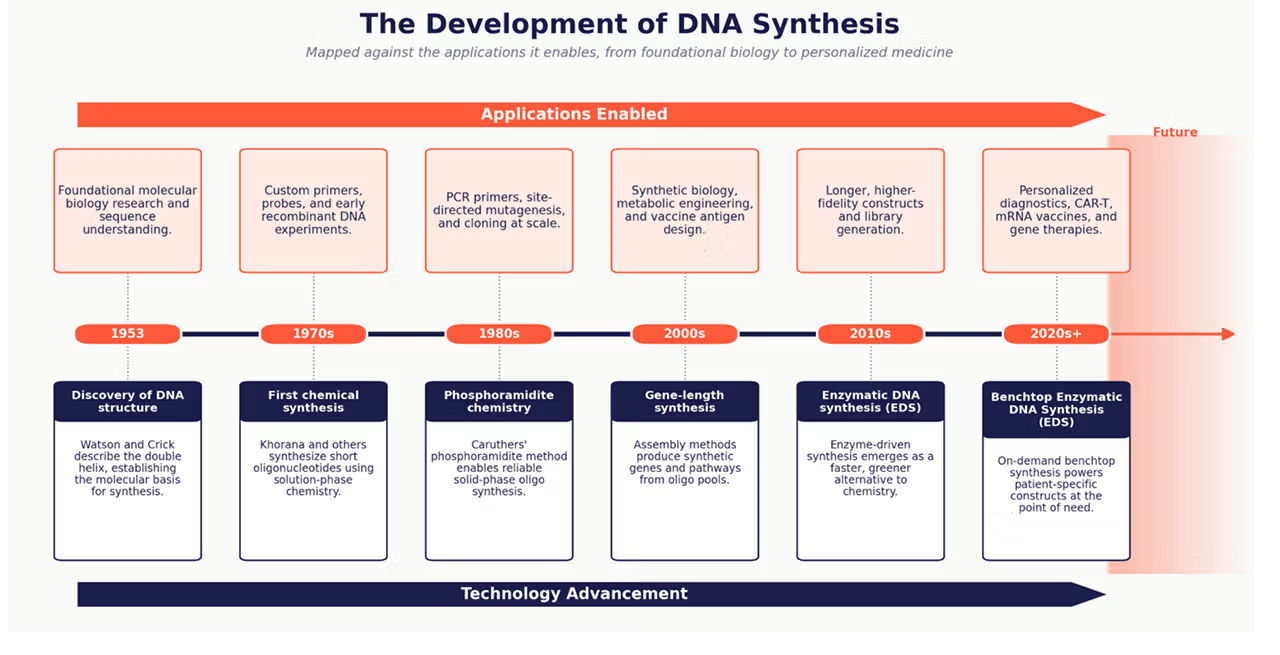
Figure 1. The development of DNA synthesis, from the discovery of the DNA structure through to Enzymatic DNA Synthesis (EDS), mapped against the applications each stage unlocked.
New Therapeutic Modalities Are Rewriting the Requirements
mRNA vaccines, viral vectors, and gene-editing therapies all depend on precisely defined genetic constructs, making DNA a critical determinant of final product quality.[5]
These modalities are introducing fresh manufacturing demands. Constructs are getting longer and more complex, frequently combining multiple functional domains that must be assembled with high precision. Meanwhile, development timelines keep shrinking — especially in personalized medicine and vaccine development, where speed, flexibility, and scalable production have become non-negotiable.[6] Conventional synthesis methods can struggle here, particularly with sequences that are long, complex, repetitive, or hard to maintain consistently through biological production. Plasmid-based workflows that rely on bacterial propagation introduce inherent biological variability, which drives up quality control burden, undermines predictability, and stretches out timelines. Cell-free production methods, including newer enzymatic DNA synthesis (EDS) approaches, sidestep this by removing the dependency on living host cells. Operating in a programmable environment, these systems can deliver stronger sequence fidelity, more consistent output even for difficult constructs, and faster turnaround with less variability. That combination is especially valuable for applications demanding rapid iteration, reproducibility, and manufacturing that can scale inside regulated settings (Figure 2).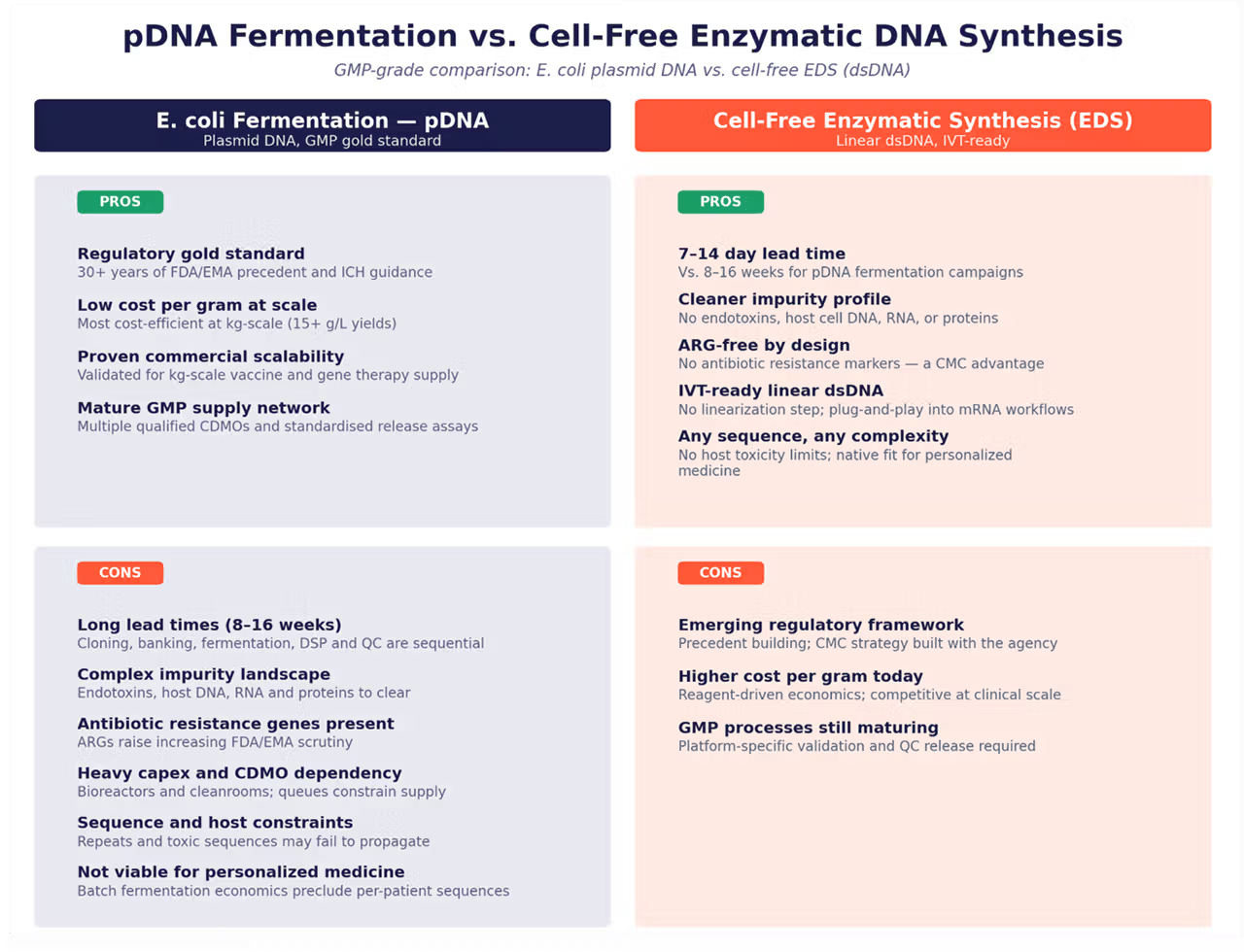
Figure 2. pDNA Fermentation vs Cell-Free Enzymatic DNA Synthesis. ARG, antibiotic resistance gene-free; CDMO, contract development and manufacturing organization; CMC, chemistry, manufacturing, and controls; DSP, downstream processing; GMP, good manufacturing practice; IVT, in vitro transcription; pDNA, plasma DNA; QC, quality control. Figure courtesy of the author.
As a result, platforms that can combine high fidelity, manufacturing flexibility, and scalable throughput are drawing growing interest as enablers of next-generation therapeutics.
Biofoundries: Closing the Loop Between Design and Manufacturing
Biofoundries have emerged as one answer to the mounting manufacturing demands of next-generation therapeutic modalities, and they also mark a broader shift toward integrated, “lab-in-the-loop” development that speeds up the cycle from design to testing. By bringing together automation, robotics, software, and advanced cell-free enzymatic DNA synthesis, these facilities support high-throughput biological engineering and more agile development.[7] For applications like personalized medicine, mRNA vaccines, and cell and gene therapies, the manufacturing playbook is changing. Timing, scalability, and sequence fidelity now matter more than ever, often calling for smaller batches, faster iteration, and greater production flexibility than traditional models were built to deliver. Biofoundry platforms may offer real advantages here, enabling manufacturing that’s more rapid, programmable, and potentially more localized. By tightly integrating design, build, and test steps, biofoundries can compress production timelines from months down to days, sharpen development efficiency, and give organizations more control over intellectual property and supply chains. Pairing these facilities with digital systems and automated quality workflows can also support good manufacturing practice (GMP) compliance and strengthen reproducibility within regulated settings.[8] That said, established E. coli fermentation-based plasmid manufacturing remains the industry’s gold standard for many large-scale applications, thanks to its maturity, scalability, and cost efficiency. Building in-house DNA manufacturing capability still demands significant investment in infrastructure, automation, and expertise. The likely outcome is a hybrid manufacturing landscape, one that blends established centralized production with newer automated, cell-free capabilities suited to the demands of advanced therapeutics.
Faster Iteration Without Sacrificing Control
Weaving DNA synthesis directly into development workflows changes how therapeutics get designed in the first place. Many modern platforms lean on iterative design–build–test cycles, where the pace and efficiency of each loop directly shapes development outcomes.[9] Bringing DNA production closer to the design process cuts delays and enables faster experimentation. But in regulated environments, that flexibility has to be balanced against the need for documentation, validation, and reproducibility, and striking that balance is one of the central challenges facing organizations that want to fold synthesis capability more tightly into their pipelines.
DNA Synthesis Is Becoming Manufacturing Infrastructure
Speed still matters, but the real value of DNA synthesis in modern biopharmaceutical manufacturing is increasingly tied to quality, reproducibility, scalability, and regulatory fit. As mRNA vaccines, gene therapies, and cell therapies mature, DNA is shedding its old identity as a standalone research reagent and taking on a new role as a critical piece of continuous manufacturing infrastructure. This shift is part of the broader industrialization of DNA synthesis, propelled by advances in synthesis technology, rising therapeutic demand, and evolving regulatory expectations. Biofoundries and other integrated production models may help meet these needs, though adoption will likely vary by application and by region. Expect a hybrid ecosystem to take shape, blending centralized manufacturing with selective in-house synthesis capability. Biosecurity and governance frameworks will also play an increasingly important role in shaping how DNA synthesis technologies are deployed worldwide, influencing both market structure and the pace of technological development. Ultimately, DNA synthesis is moving beyond its origins as a research-enabling tool to become a foundational pillar of biopharmaceutical manufacturing. The future of synthetic biology depends not only on advances in genetic design, but on the ability to manufacture DNA reliably, safely, and at industrial scale.
Learn more about DNA Script’s biofoundry solution, ENCODEX.
Discover MoreRelated Articles
What Does It Take to Build a Biofoundry for Therapeutic DNA Manufacturing?
Read More
A New Paradigm: Programmable Biology Needs Programmable Manufacturing
Read More
Poly(A) Tails and the Pace of mRNA Innovation
Read More

Is outsourced oligo supply slowing down your gene synthesis work?
Read More
![[Webinar Recap] New Approaches to Gene Construction Using Our Enzymatic DNA Synthesis](https://www.dnascript.com/wp-content/uploads/2025/06/Design-sans-titre-300x300.jpg)
[Webinar Recap] New Approaches to Gene Construction Using Our Enzymatic DNA Synthesis
Read More