
Enzymatic DNA Synthesis
With better tools comes better understanding

Our disruptive Enzymatic Synthesis Technology is transforming how molecular biology contributes to human health, diagnostics, and personalized medicine.
how it works
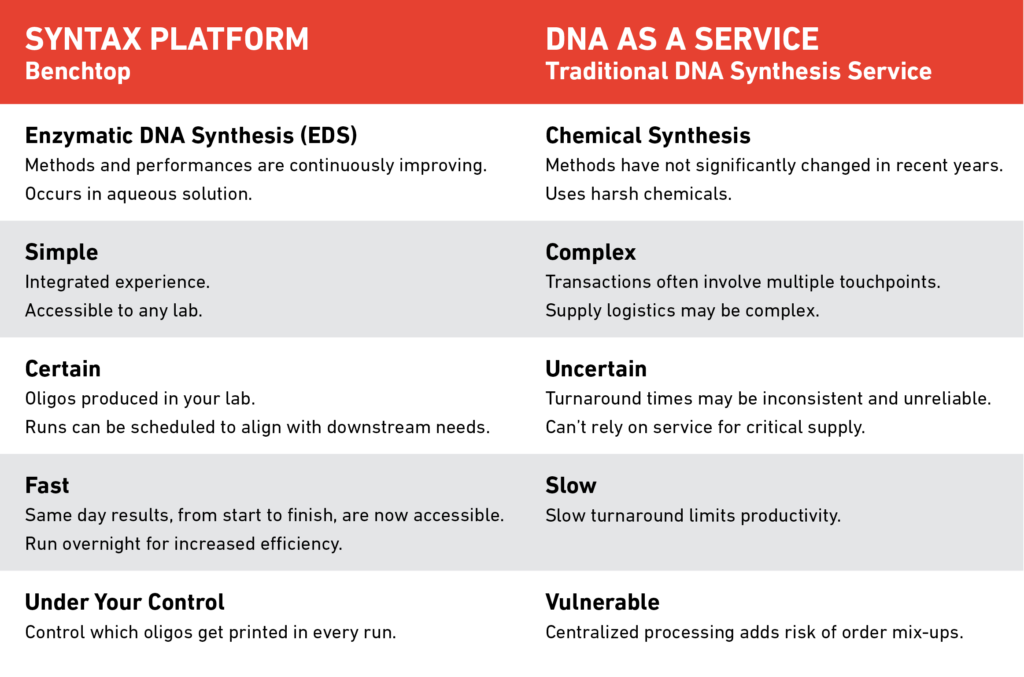
Advantages of EDS
SYNTAX PLATFORMBenchtop Instrument |
DNA AS A SERVICECentralized, 3rd-Party Services |
|---|---|
| Enzymatic DNA Synthesis Methods and performances are continuously improving. Occurs in aqueous solution. |
Chemical Synthesis Methods have not significantly changed in recent years. Uses harsh chemicals. |
| Simple Integrated experience. Accessible to any lab. |
Complex Transactions often involve multiple touchpoints. Supply logistics may be complex. |
| Certain Oligos produced in your lab. Runs can be scheduled to align with downstream needs. |
Uncertain Turnaround times may be inconsistent and unreliable. Can’t rely on service for critical supply. |
| Fast Same-day results, from start to finish, are now accessible. Run overnight for increased efficiencies. |
Slow Slow turnaround limits productivity. |
| Under your control Control which oligos get printed in every run. |
Vulnerable Centralized processing adds risk of order mix-ups. |
technology innovations
Synthesis Enzymes
DNA Script has developed and optimized a portfolio of proprietary synthesis enzymes engineered to perform de novo synthesis of nucleic acids with high fidelity and high coupling efficiency.
Reversibly Terminated Nucleotides
DNA Script has developed a range of modified nucleotides containing a reversible terminator on the 3’ position to enable the incorporation of just one nucleotide per addition cycle.
Surface Chemistry
DNA Script uses a surface chemistry with two key functions: a
solid support and predefined initiator DNA (iDNA) linkers. The
physical properties and chemical properties of the solid support are optimized to enable the synthesis of full-length DNA to support molecular biology and genomics applications and provide a surface to which the iDNA is bound. The iDNA contains an enzymatically cleavable nucleotide and uniquely can be customized to incorporate a conserved sequence into each oligo synthesized.
The 2-Step Enzymatic Synthesis Revolution
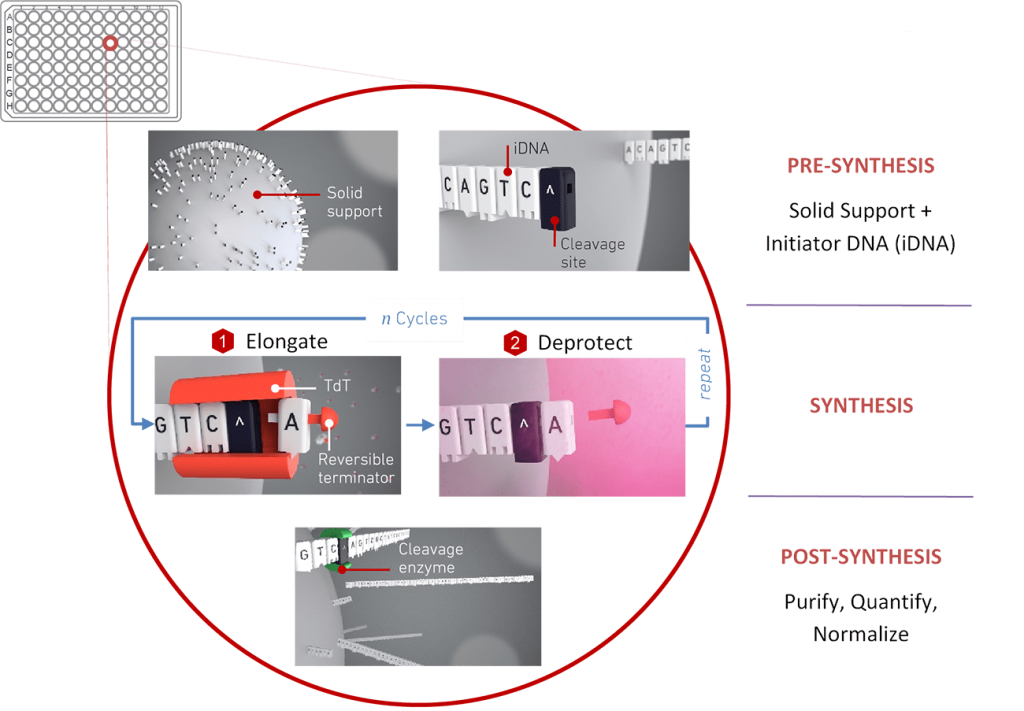
Oligos are enzymatically synthesized in a cyclic, 2-step process:
Step 1. Elongate: The TdT enzyme adds a single nucleotide to the iDNA.
Step 2. Deprotect: The reversible terminator of the nucleotide is removed, leaving the strand ready to be elongated again.
Steps 1 and 2 are repeated until the longest oligo on the plate is completed.
Following completion of the last synthesis cycle, enzymatic cleavage is performed to release oligo sequences downstream from the cleavage site. The resulting oligos are desalted, quantified, and normalized. Molecular biology-ready oligos are collected, immediately ready for the next step of the molecular biology workflow, and the SYNTAX System may be prepared for another run within just 30 minutes.